
Fatal Rajanpur Highway Crash Spotlights Pakistan Freight and Transit Vulnerabilities
A high-speed bus collision in southern Punjab has killed 10 and injured 44, escalating scrutiny over the Indus Highway's hazardous conditions and broader supply chain disruptions.
The Core Development
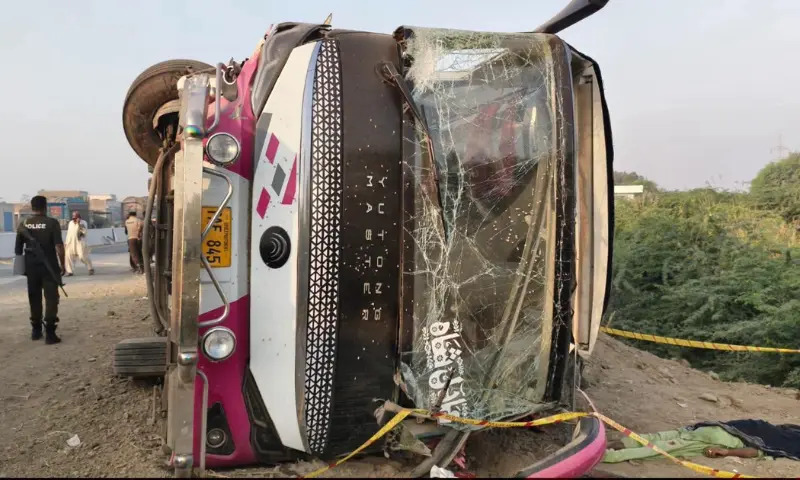
A catastrophic road traffic incident claimed the lives of at least ten passengers and left 44 others injured early Wednesday morning when a long-distance passenger coach overturned on the Indus Highway (N-55) in Punjab's Rajanpur district. According to emergency response data released by Punjab Emergency Service Rescue 1122, the crash occurred at approximately 5:45 AM near the Bangla Hidayat corridor within Rojhan tehsil.
Preliminary investigations indicate that the passenger vehicle was traversing the inter-provincial corridor at high speed when the driver lost directional control, colliding forcefully with a concrete road median before toppling onto its side. The impact killed seven adult males, two women, and a minor girl on the spot. Emergency dispatchers mobilized 35 specialized first responders alongside ten ambulances and two heavy rescue vehicles originating from Rajanpur, Jampur, and Rojhan bases.
Medical emergency units transferred 38 injured passengers to the Rajanpur District Headquarters (DHQ) Hospital for urgent trauma intervention. Four critically injured individuals were subsequently routed to the tertiary-care medical facility in Dera Ghazi Khan, while two others presenting life-threatening trauma were shifted to the Sheikh Zayed Hospital in Rahim Yar Khan. The National Highways and Motorway Police (NHMP) cordoned off the segment to facilitate salvage operations and restore north-south traffic movement along this key logistics artery.
Commercial & Economic Implications
The Indus Highway constitutes Pakistan's vital secondary transport spine, facilitating substantial freight movement between Karachi's maritime ports and the agrarian and industrial hubs of southern Punjab, Khyber Pakhtunkhwa, and Balochistan. High-casualty incidents along the single-carriageway and poorly separated stretches of the N-55 impose measurable economic drag on wholesale distribution networks and agrarian supply chains.
Recurring collisions on this arterial route lead to periodic road closures, triggering extended transit delays for perishable farm produce, agricultural inputs, and manufactured commercial goods. For regional wholesale traders in south Punjab, chronic corridor unreliability inflates buffer inventory requirements and escalates logistical friction. Furthermore, elevated incident frequencies across central and southern transport corridors are compelling domestic freight operators and passenger transport syndicates to factor higher depreciation, vehicle repair reserves, and transit insurance premiums into baseline hauling tariffs, ultimately feeding through to higher retail shelf prices.
Beyond direct logistical friction, systemic traffic trauma exacts a compounding toll on domestic human capital and labor mobility. Working-class migrant laborers relying on affordable intercity bus transit bear the brunt of these structural safety deficits, increasing the operational liabilities of commercial transporters operating on narrow margins.
Related Intelligence: Kenya Health Crisis Sparks US Travel Advisory Amid Regional Trade Vulnerabilities
Stakeholder Perspectives & Market Reactions
Regional trade chambers and intercity transport federations across Punjab and upper Sindh have registered mounting frustration over stalled arterial infrastructure modernization. Transporters argue that while significant public investment has flowed into prime motorway corridors, the heavily trafficked Indus Highway remains prone to lethal structural hazards, inadequate road markings, and absent lighting along critical sections.
Logistics operators note that long-haul drivers on secondary national corridors face grueling schedules without institutional rest-break enforcement, directly contributing to fatigue-induced, high-speed collisions. Legal experts and consumer rights bodies have called for rigorous vehicle fitness audits and systemic speed enforcement, pointing to regulatory failures within provincial transport authorities. Public health officials in south Punjab have similarly underscored the ongoing strain placed on tertiary healthcare infrastructure, where trauma centers regularly operate beyond capacity responding to large-scale highway emergencies.
Forward Outlook & Key Watchpoints
In the immediate wake of the Rojhan crash, the National Highway Authority (NHA) and provincial enforcement regulators face renewed pressure to accelerate the comprehensive dualization and rehabilitation of the N-55 corridor. Key watchpoints over the coming quarters include the execution timeline of Asian Development Bank (ADB)-assisted dualization packages earmarked for the Rajanpur-Dera Ghazi Khan segments.
Additionally, commercial fleet operators are closely monitoring whether the NHMP will implement automated speed monitoring and stricter driving hour limitations on heavy transport vehicles operating through vulnerable rural choke points. Progress on these regulatory and infrastructural milestones will determine whether freight and passenger operations along this critical domestic artery can achieve sustainable stability or continue to suffer costly structural interruptions.
Join Our Official WhatsApp Channel
Receive live commodity alerts, policy changes, and commercial intelligence directly on WhatsApp.