
Dutch Riot Police Suppress Violent Far-Right Clashes in The Hague
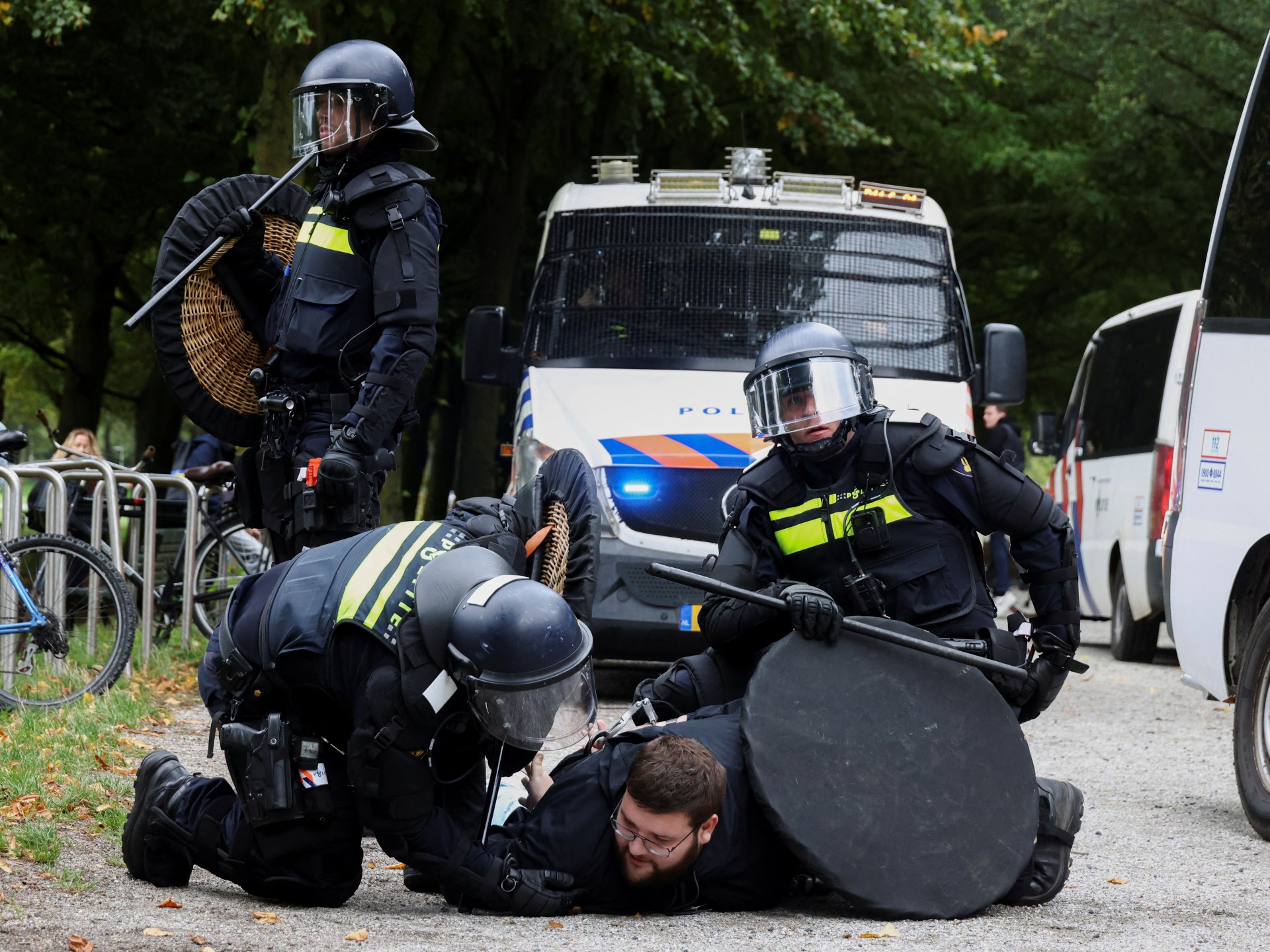
Dutch riot police intervened against violent far-right demonstrators in The Hague on Saturday, prompting government condemnation and exacerbating concerns over domestic political stability in Western Europe.
Geopolitical & Core Developments
Dutch law enforcement deployed specialized riot units, mounted officers, and water cannons in The Hague on Saturday to suppress violent clashes during an unpermitted anti-immigration demonstration. The gathering, organized by disparate far-right factions, deteriorated into widespread disorder as demonstrators targeted police lines with projectiles, fireworks, and physical assaults. Justice Minister David van Weel issued an unequivocal rebuke of the unrest, explicitly condemning the public display of Hitler salutes, antisemitic slogans, and premeditated violence directed at civil authorities. The unrest occurred in the administrative heart of the Netherlands, an international hub hosting prominent multilateral institutions including the International Court of Justice. The escalation reflects an increasingly volatile domestic landscape following months of fraught political realignment that brought hardline anti-immigration rhetoric to the forefront of national policy. Observers note that while the Dutch state has traditionally maintained high institutional resilience, the normalization of radical street movements highlights growing systemic friction within Western European democracies.
Global Trade & Economic Ripples
While localized civil unrest rarely disrupts direct macroeconomic indicators immediately, persistent socio-political instability carries substantial implications for Dutch commercial hegemony. As the primary maritime and logistical gateway into Western Europe—anchored by the Port of Rotterdam and extensive inland freight corridors along the Rhine—the Netherlands depends on cross-border fluidity and social cohesion. Mounting pressure from hardline political factions to reimpose internal border verifications threatens the integrity of the Schengen framework, potentially inducing transit delays across intra-European supply chains. Elevated friction at Dutch transit junctures could increase freight carrying costs, introduce unpredictability into just-in-time manufacturing networks, and constrain access to critical cross-border labor pools that sustain Dutch agribusiness and distribution infrastructure. Furthermore, recurring urban volatility risks denting international investor sentiment toward Dutch sovereign debt instruments and municipal infrastructure portfolios, which traditionally command safe-haven status within European capital markets.
International Reactions & Diplomatic Stances
The events in The Hague triggered immediate condemnation across international diplomatic and regulatory bodies. Officials from the European Commission reiterated the necessity of upholding fundamental civic rights while demanding strict enforcement against hate speech and extremist violence that violate European Union core treaties. Human rights agencies and international watchdog groups expressed alarm over the brazen revival of antisemitic and neo-fascist symbols within a major European capital, calling on member states to strengthen intelligence monitoring of transnational far-right networks. Concurrently, neighboring European capitals, including Berlin and Brussels, are monitoring developments closely due to the potential cross-border spillover of nativist agitation. European trade unions and transport federations have also called for heightened security measures around vital transit arteries to safeguard freight personnel from civil disturbances.
Strategic Outlook & Future Scenarios
Moving forward, the Netherlands faces a precarious trajectory characterized by heightened social cleavages and intense parliamentary scrutiny. Analysts anticipate that right-wing factions will leverage the public unrest to demand more punitive asylum controls and expedited deportations, accelerating policy clashes with EU regulatory directives on migration and human rights. Should street-level demonstrations become institutionalized or spread toward major logistics hubs such as Rotterdam or Amsterdam-Schiphol, the Dutch cabinet may face calls to deploy emergency public-order protocols. Such measures could lead to sporadic transport halts and logistical bottlenecks across Northern Europe. Over the coming quarters, international stakeholders will closely watch whether the coalition government can stabilize public security without compromising foundational democratic norms, or whether ideological fragmentation will increasingly erode the operational predictability that defines the Dutch commercial landscape.
Join Our Official WhatsApp Channel
Receive live commodity alerts, policy changes, and commercial intelligence directly on WhatsApp.